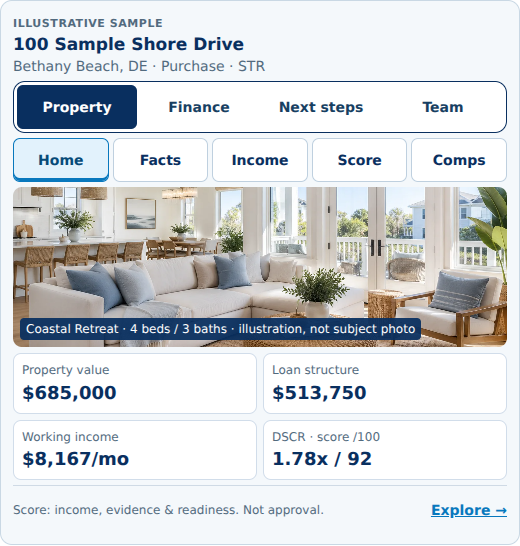
Start with a reviewable property record.
Verify the address, review income and capital assumptions, and save the opportunity. Request human financing review when you are ready.
Analyze a PropertyInvestor paths and client situations
First purchase, refinance, LLC ownership or portfolio growth? Choose your situation, research the property and compare financing before deciding your next step.
Your situation
You have a property in mind but need a decision framework.
Review the rental model, income evidence, operating costs and full acquisition budget. Compare preliminary financing, then identify the facts to verify before committing.
First rental purchase guideVerify the address, review income and capital assumptions, and save the opportunity. Request human financing review when you are ready.
Analyze a PropertyYour situation
Your current loan, title or intended use needs another look.
Compare the current debt with refinance choices. Include costs, prepayment terms, remaining amortization and ownership requirements. Confirm the appropriate transaction sequence before changing title.
Refinance considerationsVerify the address, review income and capital assumptions, and save the opportunity. Request human financing review when you are ready.
Analyze a PropertyYour situation
You want to review whether existing equity could support another business-purpose objective.
Compare estimated proceeds after payoff and charges, retained equity, the new payment and a lower-income case. Available equity is not automatically available cash.
Explore the financing reviewVerify the address, review income and capital assumptions, and save the opportunity. Request human financing review when you are ready.
Analyze a PropertyYour situation
You are comparing additional properties or financing for existing rentals.
Save opportunities, use consistent assumptions and compare cash needs, evidence gaps and operating demands. Lender exposure and portfolio requirements may apply.
Portfolio investor guideVerify the address, review income and capital assumptions, and save the opportunity. Request human financing review when you are ready.
Analyze a PropertyYour situation
Several people need to agree on the property and capital plan.
Review cash contributions, reserves, authority to borrow and potential guarantees. Invite relevant reviewers through the platform and resolve ownership questions with your attorney and CPA.
Multi-member LLC financingVerify the address, review income and capital assumptions, and save the opportunity. Request human financing review when you are ready.
Analyze a PropertyThe workspace holds saved purchase and refinance properties so you can revisit assumptions and review different opportunities.
Compare the property evidence and full cash requirement. A platform score or preliminary financing match does not establish suitability or approval.
Review seasonality, market evidence, operating costs and permitted rental use.
Airbnb and STR financingReview extended-stay demand, agreements, included services and vacancy gaps.
Mid-term rental financingReview leases, comparable rent, collections, vacancy and maintenance.
Long-term rental financingKeep those questions with your qualified professional team. A tax, retirement or family objective does not make an otherwise weak property suitable.
Bring the property facts, cash needs and any proposed tax strategy to your CPA and financial adviser. Do not assume property deductions will offset a conversion or produce a particular result.
Have your advisers review distributions, liquidity, income-sensitive costs and the demands of property ownership. STR Advisory does not determine retirement or Medicare outcomes.
Your financial adviser should evaluate portfolio fit, liquidity and concentration. Compare property risks, capital needs and operating responsibilities alongside the income estimate.
Your attorney and CPA should review governance, authority, succession and tax treatment. Prepare the property and financing facts so the professional discussion uses consistent information.
Financial adviser collaboration · Professional partner roles · Primary-source resources
Verify intended use, income evidence, condition and realistic expenses. Test a downside case.
Include cash to close, initial work and operating reserves. Review what remains available for other needs.
Resolve ownership and document questions, confirm possible lender fit and use the secure application process when ready.
Analyze the property. Compare the financing. Prepare the transaction.
Situations are prompts for investigation, not recommendations or promises of income, financing or tax results. Preliminary outputs are not applications, approvals, rate locks or commitments. STR Advisory arranges eligible financing through third-party lenders and does not fund loans or make credit decisions. Legal, tax and financial-planning decisions require appropriate professional review.