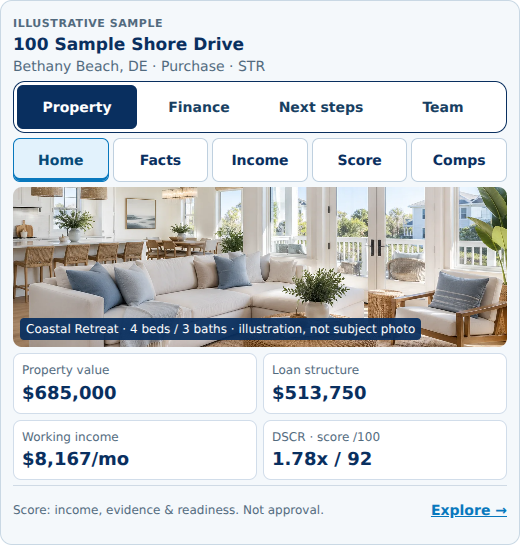
Should I buy this STR?
Review estimated income, comparable rentals where available, operating expenses, cash required and financing assumptions before committing.
Buying your first rentalAirbnb and short-term rental financing
Research projected rental income, test expenses and compare estimated rates and payments. See how the property may perform before committing to a purchase or refinance.
Free registration required to view estimated rates and save your research. No sales call required. Contact our team when you choose. Estimates are subject to lender review.
Review estimated income, comparable rentals where available, operating expenses, cash required and financing assumptions before committing.
Buying your first rentalCompare an existing loan with possible refinance structures. Review current use, title, costs and income evidence.
Explore the refinance pathEvaluate potential cash-out proceeds, retained equity and payment changes. Confirm the new debt can withstand lower income.
Explore a property financing reviewResearch income first
Use available market data and comparable rentals to examine a property’s potential. Check whether the comparisons match its location, size, amenities, condition and rental use.
Review seasonality, management, platform costs, utilities, maintenance and reserves. An annual revenue estimate can hide months when cash is tight.
The lender may accept a different income source or apply different adjustments. Keep research income, lender qualification income and operating cash flow distinct.
There is no single income method accepted by every STR lender. Our review starts by matching your available evidence with possible program requirements.
Booking records, revenue statements and management reports help document performance. Confirm the required history, permitted adjustments and supporting records with the lender.
For a purchase or property without established history, some programs may consider an approved projection. Report provider, format, property fit and adjustments are lender-specific.
Some programs use appraiser-supported long-term rent. This may differ significantly from projected nightly revenue, so compare the financing result under that method.
DSCR compares qualifying income with the lender-defined payment obligation. For many residential rental programs, the obligation includes principal, interest, taxes, insurance and applicable association dues.
A property may show positive operating cash flow under your assumptions and still fail a particular lender’s income test. It may also meet a DSCR target while leaving too little cash after operating expenses.
Understand DSCR financingHypothetical example
The required qualifying income would be $3,600 per month, or $43,200 per year.
If accepted qualifying income is $4,000 per month, illustrative DSCR is 1.33.
This is a calculation example, not a lender requirement or approval. The payment components, accepted income and minimum ratio vary. Annual gross booking revenue is not automatically qualifying income.
Compare cash and payment
Compare cash needed, retained liquidity, estimated payment and debt coverage at different down payments. Include closing costs, initial furnishings, repairs and reserves.
Then compare rate, points and prepayment provisions. Where eligible choices are available, save the option you want reviewed.
Compare loan structuresVerify local rules, permits, association restrictions, insurance and property-specific requirements independently. A platform listing or revenue estimate does not establish legal rental eligibility.
Review evidence gaps and assumptions. Consider lower occupancy, nightly rates or both, and confirm which evidence the lender accepts.
Include full operating costs and reserves. An annual average can conceal seasonal shortfalls.
Compare eligible investment financing with your actual intended operation. Existing second-home loans should be reviewed against their occupancy and use terms.
Some business-purpose programs permit eligible entities. Review ownership, guarantor, title and document requirements before choosing a structure or transferring an existing property.
Our platform can organize the property scenario for discussion with your LLC members and professional reviewers. Your attorney and CPA should advise on ownership and tax treatment.
Multi-member LLC considerationsSave properties in your workspace and review the income evidence, financing assumptions and cash needs side by side in your decision process. Keep assumptions consistent.
For portfolio growth, account for existing obligations and liquidity. Lenders may have exposure limits and other portfolio requirements.
Explore portfolio growthVerify the address, review rental income and expenses, and save the property in your account.
Review eligible preliminary choices, cash required and downside assumptions. Save a preference for review.
Our team reviews evidence and program fit, then coordinates the appropriate application and document process if you proceed.
Potentially. Some programs consider approved projections or comparable rent, subject to property, borrower and program requirements. A market estimate alone does not establish eligibility.
No. Property income may be central to qualification, but credit, reserves, liquidity, guarantors, ownership and other underwriting requirements still apply. Documentation varies by program.
No. STR Advisory is independent of those platforms. We arrange eligible business-purpose loans with third-party lenders.
Eligible rate-and-term or cash-out programs may be available. Review the current loan, title, property value, income evidence, seasoning, costs and proposed terms.
No. They are captured examples. App estimates remain preliminary and require verification; approval and final terms depend on lender review.
Review the income. Compare the financing. Prepare the next step.
Preliminary outputs are not an application, approval, rate lock or commitment. Income and cash-flow estimates are not guarantees. STR Advisory arranges eligible financing through third-party lenders and does not fund loans or make credit decisions. Financing depends on documentation, underwriting, borrower and property eligibility, applicable licensing and state requirements.

