Rent and included services
Identify the contract amount and who pays utilities, internet, cleaning and other services. Furnished rent and unfurnished market rent can differ.
Mid-term and furnished-rental financing
Analyze furnished rental income, vacancy and operating costs for a purchase or refinance. Compare estimated financing with the income evidence your lender will need to review.
Free registration required to view estimated rates and save your research. No sales call required. Contact our team when you choose. Estimates are subject to lender review.
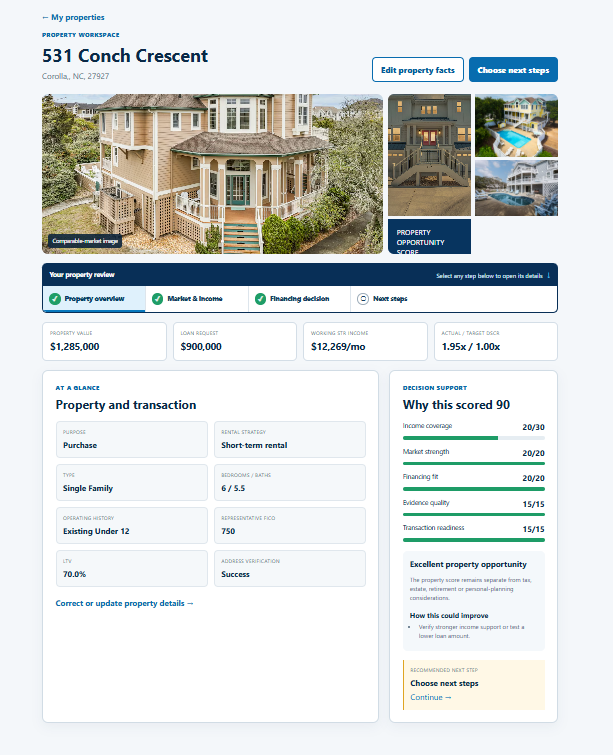
Mid-term rentals often serve guests staying for weeks or months: relocating employees, traveling professionals or households needing temporary housing. The label alone does not determine lender treatment or legal requirements.
Identify the contract amount and who pays utilities, internet, cleaning and other services. Furnished rent and unfurnished market rent can differ.
Allow time for vacancy, cleaning and maintenance. A strong occupied-month rent does not establish a full year of income.
Research relevant demand sources and competing furnished rentals. Verify local rules, association restrictions, insurance and tenancy obligations independently.
Accepted evidence and adjustments vary by lender. Keep the operating plan separate from the income a particular program permits for qualification.
Prepare signed agreements showing rent, dates, included services and payment terms. The lender determines whether and how the agreements are accepted.
Organize booking records, revenue statements, management reports and supporting payment records. Identify gaps, cancellations and inconsistent periods.
For a property without history, review comparable rent or another approved report where permitted. Nightly STR projections should not automatically stand in for furnished monthly demand.
Our human review checks possible program fit and missing evidence before you proceed to the appropriate application process.
Illustrative operating test
Suppose a furnished rental earns $3,600 for each occupied month and is occupied for 10 months. Annual gross rent is $36,000, equivalent to $3,000 per month averaged over the year.
Assume $900 per month of operating expenses averaged over the year, excluding debt service, and $1,900 of monthly debt service. The illustrative remainder is $200 per month before additional reserves and capital spending.
At nine occupied months, average gross rent falls to $2,700 per month. With those same expense assumptions, the remainder becomes negative $100 per month.
If a lender accepts $3,000 of qualifying monthly income and defines the monthly payment obligation as $2,400, illustrative DSCR is 1.25.
The lender’s $2,400 obligation and your expense model must be reconciled carefully so taxes, insurance or other costs are not counted twice.
Separate hypothetical illustrations—not offered terms, universal underwriting rules or a complete investment model. Lenders may use different income and payment definitions.
Understand DSCR financingInclude down payment, other closing costs, furnishings, utilities, initial work and reserves for the periods between stays.
Compare preliminary rate, points, payment, leverage and prepayment terms where eligible options are available. More cash down can lower debt while reducing the liquidity available to operate.
Compare loan structures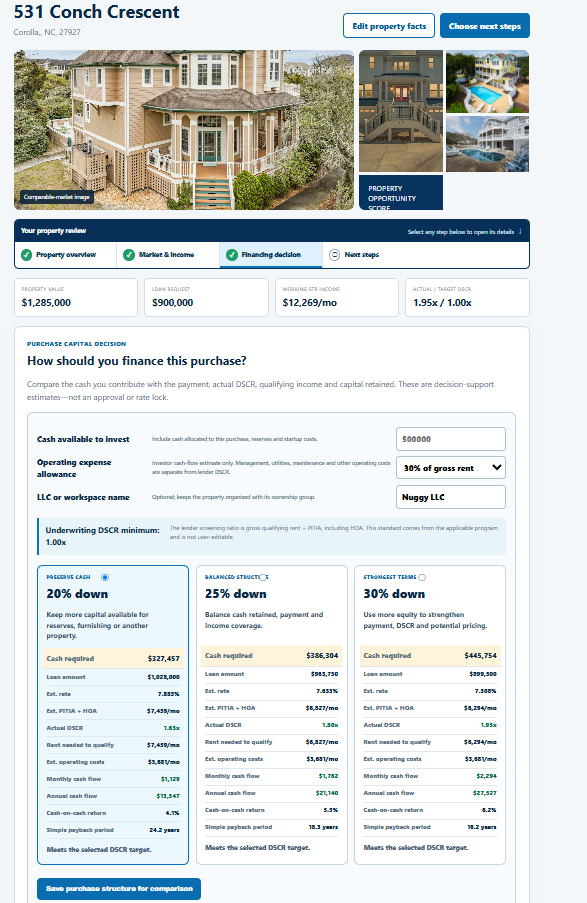
Research the furnished-rental plan, income evidence and cash needed before committing. Confirm which qualification method may be available for a property without history.
First rental purchase guidanceCompare the current balance, rate, remaining term and prepayment costs with a proposed structure. Check ownership and rental-use requirements.
Rental refinance considerationsReview estimated proceeds after payoff and charges, retained equity, the new payment and a vacancy case.
Explore a financing reviewUse the secure application and document process for sensitive borrower records when you decide to proceed.
Bring your agent, property manager, LLC members and professional advisers into the property decision. Your attorney should review contracts and ownership; your CPA should review tax treatment.
Professional collaborationVerify the property and review income, expense and capital assumptions in your account.
Review available choices and save a preference. Confirm the appropriate income method during review.
Our team checks program fit and evidence gaps. Proceed to an application when ready; the lender makes the credit decision.
No. Stay length alone does not determine program eligibility, permitted use or tenancy obligations. Verify the actual arrangement with the lender and appropriate local professionals.
No. A listing is a marketing channel, not proof of accepted income or loan eligibility. STR Advisory is independent of listing platforms.
Potentially. Accepted comparable rent, projections, agreements and other evidence depend on the lender and program. Review the available method before relying on projected income.
Ownership requirements vary. Some business-purpose programs permit eligible entities. Review the lender’s requirements and discuss ownership decisions with your attorney and CPA.
No credit pull is part of the preliminary property check. Formal financing may require credit authorization and additional information.
More financing answers · Long-term rental financing · Short-term rental financing
Analyze the property. Compare the financing. Prepare the transaction.
Outputs are preliminary estimates, not applications, approvals, rate locks or commitments. STR Advisory arranges eligible business-purpose financing through third-party lenders and does not fund loans, make credit decisions or guarantee income. Financing depends on verification, underwriting, documentation, borrower and property eligibility, applicable licensing and state requirements.