Purchase
Test projected rental income and required rent. Include closing costs, furnishings, repairs and reserves in the cash plan.
Plan the rental purchaseBooking.com rental-property financing
Review booking income, seasonality and operating costs, then compare estimated financing. Keep the assumptions and supporting records together in your property workspace.
Free registration required to view estimated rates and save your research. No sales call required. Contact our team when you choose. Estimates are subject to lender review.
An eligible rental may qualify for business-purpose DSCR financing using income evidence accepted by the lender. A Booking.com listing does not establish eligibility. Property type, permitted use, income, credit, reserves, leverage, ownership and location all matter.
Test projected rental income and required rent. Include closing costs, furnishings, repairs and reserves in the cash plan.
Plan the rental purchaseCompare the current loan with a potential replacement using documented rental activity and the full transaction cost.
Review refinance considerationsCompare estimated net proceeds, retained equity and the new payment before using equity for improvements or another purchase.
Review portfolio decisionsA reservation total can differ from money received. Account for cancellations, refunds, no-shows, adjustments and amounts still outstanding.
Organize reservation records, payment records, fee statements and relevant bank deposits. Payment arrangements can differ; use records that explain how your property collects revenue.
Identify platform fees and amounts collected for taxes or other charges. Do not assume every amount paid by a guest is qualifying rental income.
If you also use Airbnb, Vrbo or direct bookings, organize one property-level history and avoid counting the same stay or payment twice.
Buy well
Review available comparable rentals, seasonality and the difference between projected and documented income. Test lower occupancy and slower months before relying on the forecast.
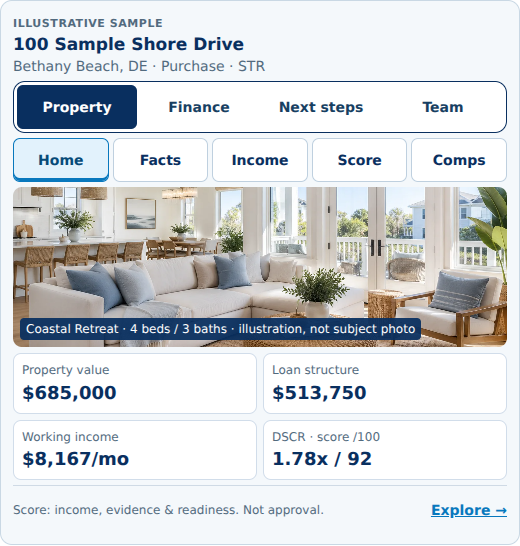
Research coverage varies. This screen illustrates an STR research workflow; it does not demonstrate a Booking.com account connection or dedicated Booking.com data feed.
See the property decision processConfirm local rules, permits, minimum stays, association restrictions and appropriate insurance. Being listed online does not establish permission to operate.
Test qualifying income against the proposed payment. Separately account for management, cleaning, utilities, maintenance, vacancy and other operating costs.
Include closing costs, furnishings, repairs and reserves. Test the effect of cancellations and slower periods on cash available for debt payments.
Finance well
Review preliminary rates, payments, points, leverage, prepayment terms and cash required. See how preserving more cash changes the payment and required income.
For a refinance, include payoff and transaction costs. For cash out, compare net proceeds with the increased debt obligation and retained equity.
Compare loan structuresIllustration only—not a lender requirement
At a hypothetical 1.20 minimum, that $3,500 obligation would require $4,200 in qualifying monthly income. The lender determines accepted evidence, adjustments, the payment definition and the required ratio.
Guest booking totals are not automatically qualifying income. DSCR also does not represent your cash remaining after operating expenses.
Understand DSCR and cash flowClearly label projections and the evidence supporting them. Asking rates and future reservations do not guarantee collected income.
Some programs allow an LLC borrower. Entity eligibility, signing authority, title and guarantees require review. Discuss legal and tax questions with your attorney and CPA.
Review shared ownershipSave the property and a preferred financing option. Our team can assess the package, identify missing information and discuss eligible next steps toward an application and secure document process.
No. The lender determines accepted records, the review period and qualifying adjustments. A listing or booking total alone does not establish eligibility.
Organize a reconciled property-level history. Avoid duplicates and explain differences between reservations, fees, refunds and collected payments. Acceptance depends on the program.
Some programs may consider approved market-income evidence; others require different support. Preliminary projections do not establish approval.
This page does not promise an account integration. Use available research and organize supporting records for review. Confirm any connection in the application before relying on it.
Do not assume a residential rental program supports hotels, hospitality operations or larger multi-unit properties. Property type and operating model require separate eligibility review.
STR Advisory is independent of Booking.com. The name identifies a rental channel and does not imply endorsement, sponsorship or a lending partnership.
Analyze the property, compare the financing, and prepare the transaction.
Preliminary estimates are not an approval, application, rate lock or commitment to lend. Financing is subject to underwriting, property and borrower eligibility, lender requirements and applicable state availability. Business-purpose financing is for eligible investment properties. Income, qualification and loan terms are not guaranteed.

