Buy Well
Understand the property, income evidence, operating costs and risks before committing.
How the property strategy works
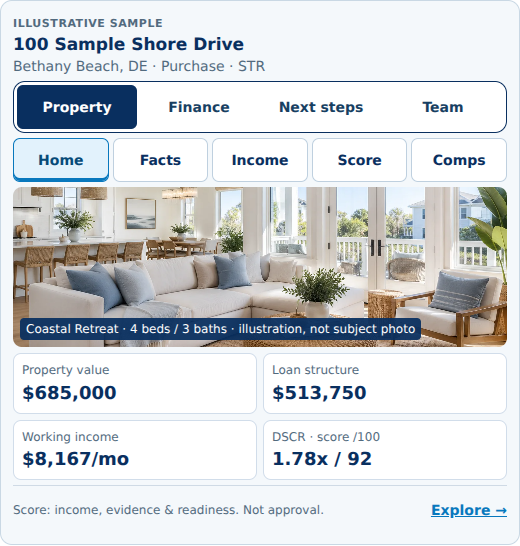
Start with a purchase or refinance. Review income and costs, compare estimated rates and terms, and save your findings. Invite a reviewer or involve our team when you’re ready.
Free registration required to view estimated rates and save your research. No sales call required. Contact our team when you choose. Estimates are subject to lender review.
Understand the property, income evidence, operating costs and risks before committing.
Compare payment, cash required, points, leverage and prepayment terms together.
Keep the property record, reviewers, evidence gaps and next steps connected.
Step 01
Choose purchase or refinance, the intended rental model, available capital and your timeline. If you are comparing several properties, use consistent decision criteria.
Choose an investor pathA defined transaction objective and assumptions you can apply to a property.
Step 02
Enter and verify the address. Check returned property details and review available market evidence, comparable rentals or actual income records. Independently verify intended use, restrictions and condition.
Review STR income evidenceA property record with evidence, estimates and facts that still need checking.
Step 03
Include management, utilities, maintenance, insurance and other costs. Add acquisition costs, initial work and reserves. Test lower income and higher expenses.
Build a first-purchase budgetA cash requirement and an operating model that show what the property depends on.
Step 04
Review lender-accepted income assumptions and debt coverage separately from operating cash flow. Compare available structures using cash needed, payment, points and prepayment terms.
Compare loan structuresA comparison of preliminary choices and the assumptions behind them. Saving a preference is not a rate lock or approval.
Step 05
Keep the opportunity in your workspace and revisit other saved properties. Compare capital needed, income evidence, financing flexibility and operating demands.
Use the reviewer invitation workflow for an LLC member, spouse, agent or professional adviser. Confirm the scope of information sharing and resolve questions within each person’s role.
Professional collaborationStep 06
Our team reviews the property package, checks possible lender fit and identifies missing information. If you proceed, use the appropriate secure loan application and document process.
STR Advisory arranges eligible business-purpose financing through third-party lenders and coordinates the transaction. The lender makes the credit decision.
Request human reviewLocal requirements, association restrictions, insurance and property condition have been appropriately checked.
Key estimates have evidence, and remaining uncertainty is visible. The lender’s income method is understood.
Closing, initial work, reserves and other commitments fit the available capital.
Lower income or higher costs do not depend on money already assigned elsewhere. Your advisers have reviewed the relevant personal-plan questions.
If these conditions do not align, revise the assumptions, compare another property, wait or decline. A score or lender approval does not replace that decision.
Review seasonality, comparable listings, operating history and lender-accepted evidence.
STR financingReview agreements, extended-stay demand, included services and vacancy gaps.
Mid-term financingReview leases or comparable rent, collections, expenses and property condition.
Long-term financingYour financial adviser can review liquidity and portfolio fit. Your CPA can review tax treatment and reporting. Your attorney can review ownership, contracts and obligations.
Tax, retirement and succession ideas require their own professional analysis. They do not establish that a rental property or additional leverage is appropriate.
Adviser collaborationExplore Property Depreciation Pro as a separate service for organizing property, furnishing and improvement records for professional review.
Prepare property documentationDocumentation is not a guarantee of deductions or tax outcomes. Review the separate service’s scope and terms.
No. Begin with available facts and reasonable estimates. Keep information gaps visible and verify them before relying on a financing or purchase decision.
No. It is decision-support information, not investment advice, proof of profitability or lender approval.
No. Human review, the formal application, underwriting and rate lock are separate steps.
Yes. Review the current loan, income evidence, value and objective for a rate-and-term or cash-out refinance scenario.
Analyze the property. Compare the financing. Prepare the transaction.
Preliminary estimates are not financing offers, applications, approvals, rate locks or commitments. STR Advisory does not fund loans, make credit decisions or guarantee income, financing or tax outcomes. Financing depends on verification, documentation, underwriting, borrower and property eligibility, applicable licensing and state requirements.
